St. Stephen Catholic School
December 4, 2025
Important updates in this week's Tidbits
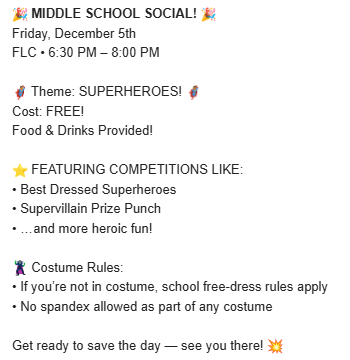
Middle School Social
Spirit Night
Volunteer Opportunities
Angels Among Us
Principal's Points
Good Afternoon St. Stephen Families.
Thank you to the parents who joined Fr. Dermot and me at the Principal’s Coffee. One parent, a college professor, shared valuable and thought-provoking insight on how early technology use has impacted student performance in post-secondary settings. When schools first moved toward integrating technology throughout the curriculum, we could not fully anticipate the long-term effects. We are now seeing that some of those effects are not as positive as hoped. As a school, we have remained attentive to this issue and have already adjusted our approach to technology integration. We will continue to learn and adapt so that we can best support our students and prepare them for success in high school, college, and beyond.
During the Principal’s Coffee, I addressed two topics before opening the floor for questions. The first topic involved updates to the Parent/Student Handbook. The previous section on “Plagiarism/Cheating” focused primarily on the student who copies information from the internet or from another student, but it did not clearly address the student who provides the work. To better reflect our expectations, this section has been renamed Academic Integrity and now reads:
“Academic integrity means upholding values like honesty, trust, fairness, respect, and responsibility in all academic work. It involves acting ethically in your own studies and when engaging with the work of others. It includes completing your own work, giving proper credit, and avoiding misconduct such as cheating or plagiarism. Upholding academic integrity ensures that academic achievements genuinely reflect one’s own learning and skills.
If a student is found to have plagiarized or cheated (copying from another student with or without their permission or using unauthorized material), the student will receive a 2 in ATL for the trimester, which will make them ineligible for the honor roll in middle school for that trimester. The student will have the opportunity to redo the assignment or assessment for a maximum grade of 85% and will receive a detention.
If a student shares their work or assessment answers with another student, he or she will also receive a 2 in ATL for the trimester and a detention; however, the student will receive full credit for their own work.”
The second topic concerned our retake policy. We recently learned that the retake policy, as originally written, is no longer a mandated Diocesan policy, and many schools have revised or discontinued it. In our middle school experience, the current retake structure has often become a crutch for students and is not an efficient use of teacher or student time. Significant portions of FLEX and intervention time are spent reteaching and administering retakes—even for students who earned, for example, an 82% and are retaking an assessment for a maximum of 85%. We believe this time is better spent helping students master concepts before assessments rather than after them.
At the same time, we recognize that some students do need additional time or support to learn material, which is why we have chosen to revise—not eliminate—the policy.
There are still a few details to finalize, and the complete policy will be published in Tidbits before Christmas. What is confirmed is that beginning after Christmas break, the middle school and elementary retake policies will be aligned. The K–5 policy has been that students earning below 70% on a summative assessment may complete a retake and this will now become the standard for middle school as well.
The unified K–8 policy will read:
“Students who score under 70% on a summative will be offered a retake for a maximum earned grade of 70%.”
Further information about the retake process will be shared within the next two weeks, and the updated policy will take effect when we return in January.
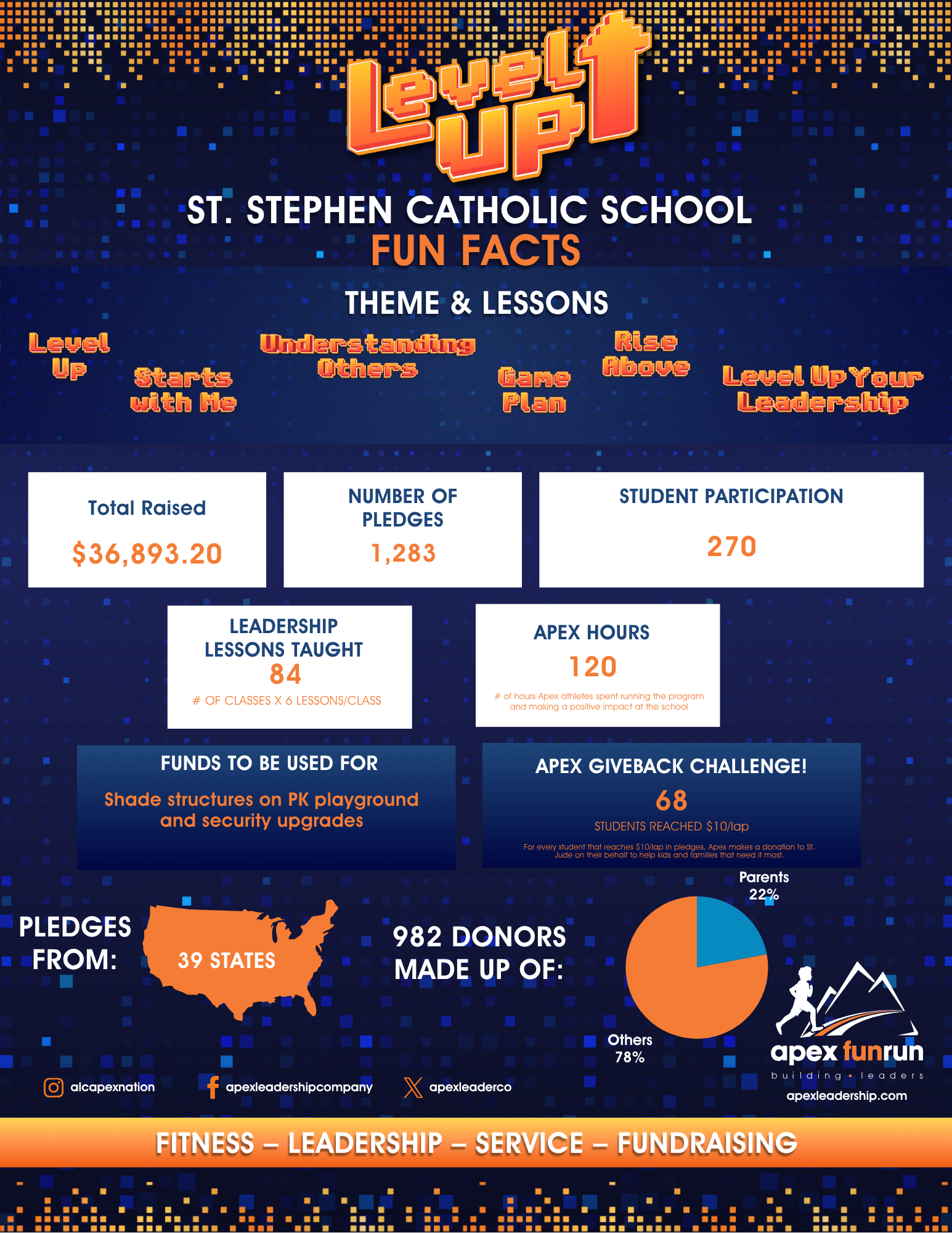
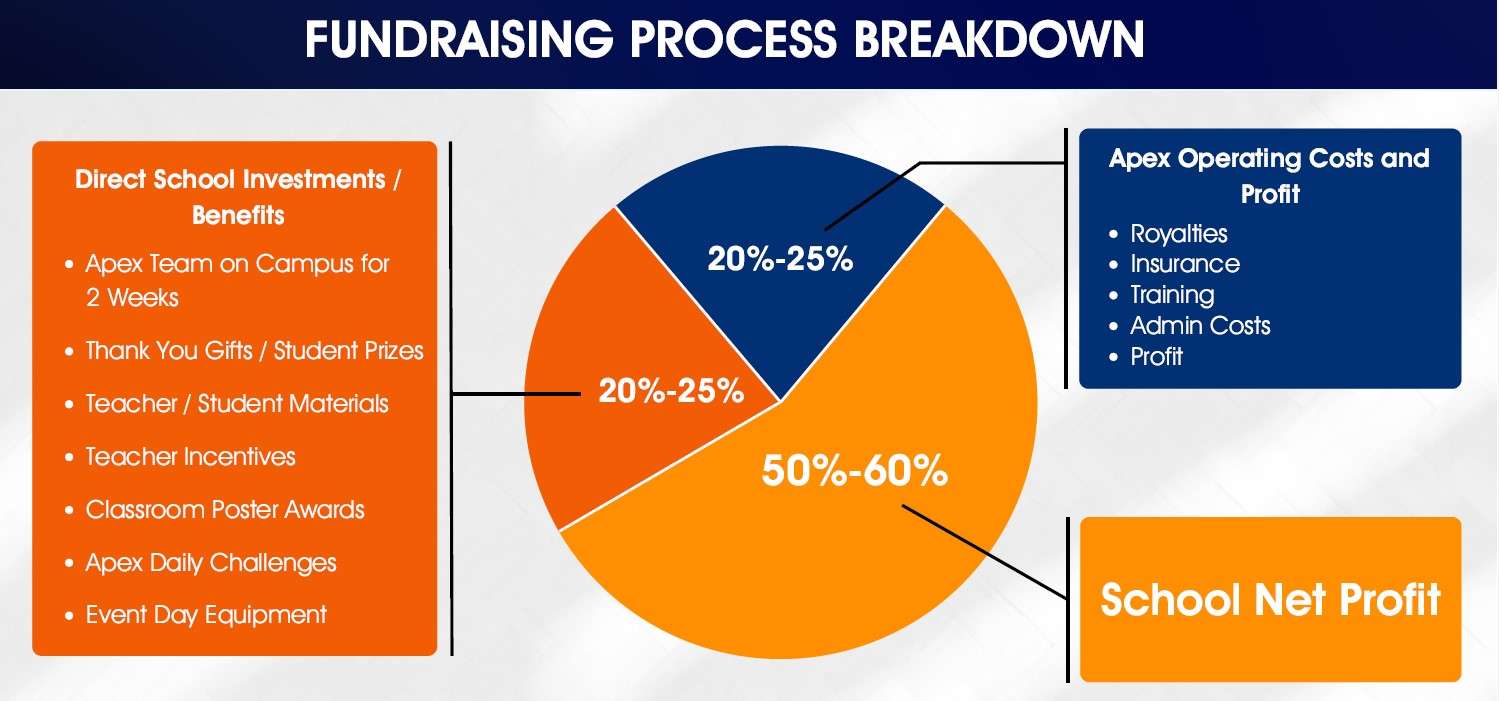
The second topic we discussed was the final results of the APEX fundraiser, which you will find below. As you can see, much of the money raised did not come from parents which is always our goal with fundraising. We also had great participation from all our families. There are two graphics below. The first shows how our school performed and the second shows the breakdown of the APEX process. The other piece of information APEX shared is that each year a school participates, they raise approximately 15-20% more each year and their average split with schools is 80/20. For our first year, the event was a success, and we gained valuable insight from the experience. At the same time, I understand the concern that approximately 40% of the funds raised did not come directly back to the school. This raises an important question: How can we create a similar high-energy, school-wide fundraiser while keeping a significantly larger portion of the proceeds?
Any large-scale fundraiser will involve some expenses, regardless of who organizes it. However, if we run the event internally, we can eliminate the labor costs and profit margin associated with using an outside company. In the coming days, you will receive a letter from the PTCO inviting parents to partner with us as we explore new possibilities. We are seeking creative ideas for how we can raise $65,000 while retaining at least 80% of the funds. Based on APEX's reporting, roughly 20% of the total raised is necessary to cover basic operating expenses for a fundraiser of this size.
Looking ahead, our next fundraiser is the Spirit Raffle, and we are actively looking for fresh ideas to enhance it—or possibly replace it with something new. One idea we have explored is partnering with a third-party company for a spring fundraiser, specifically a Read-a-thon, which would guarantee the school 77% of all funds raised.
Please take some time to consider how you might contribute—whether by offering ideas, skills, or time. Your involvement is essential as we work together to build a sustainable fundraising model for our school.
Peace,
Linda Umoh
Upcoming Events
December 1-5 - Wonderland Shop
December 5 - Middle School Social @6:30pm
December 12 - Marvelous Mustang @8am
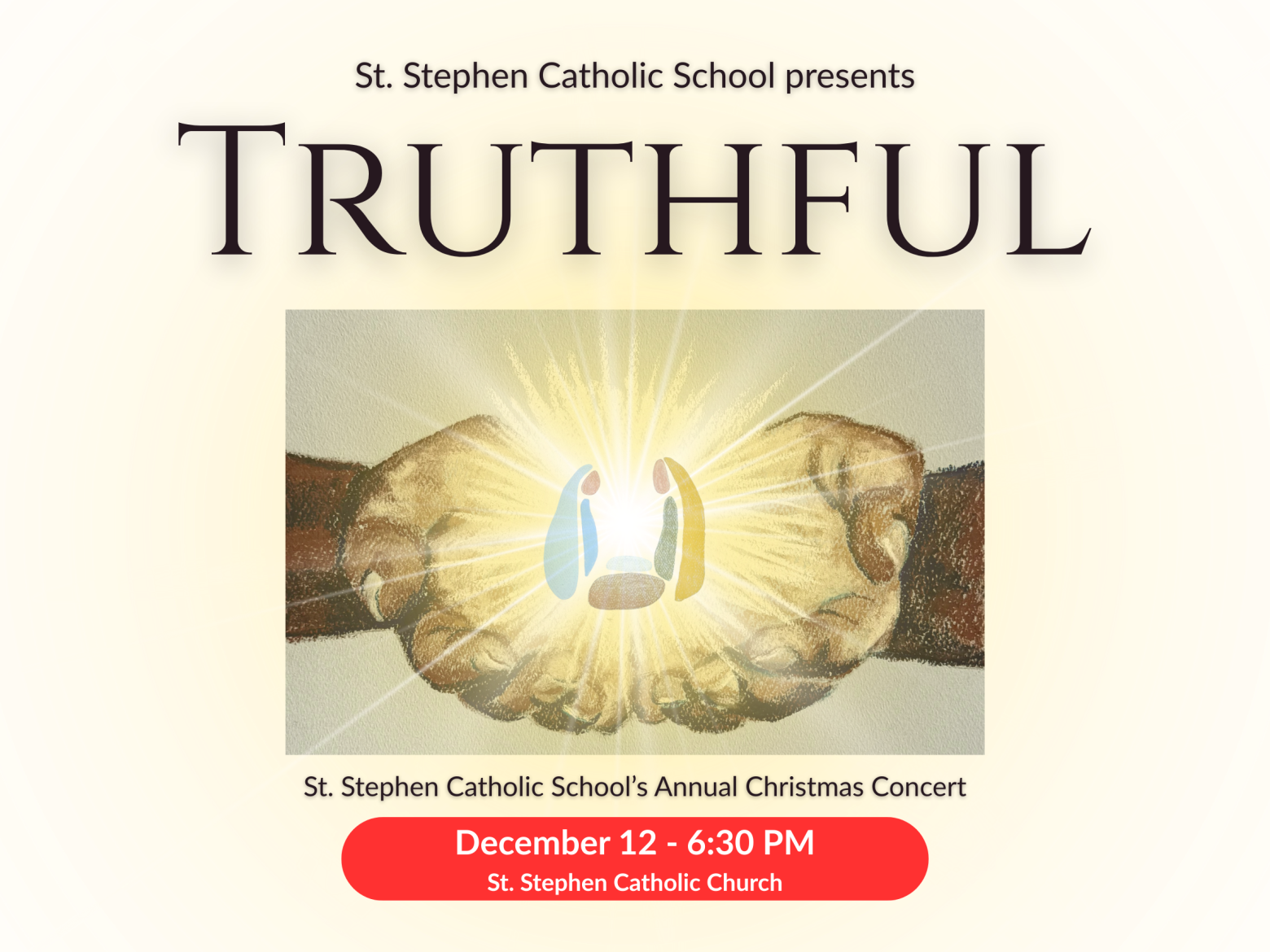
December 12 - Christmas Concert @6:30pm
December 13-14 - Holy Card Uniform Weekend
December 15 - Holy Card Free Dress
December 16-17 - Middle School Math Mid-Term Exams
December 19 - Christmas Shirt/Jean Day
December 19 - NOON Dismissal
December 19 - NO EXTENDED DAY
December 22-January 2 - Christmas Holiday/NO SCHOOL
January 5 - Classes Resume
January 10-11 - Holy Card Uniform Weekend
January 12 - Holy Card Free Dress

Angels Outreach is Collecting Used or Unwanted Christmas Decorations
Help the St. Vincent de Paul clients have a festive Christmas by donating your used or no longer needed Christmas decorations. Donations can be given to the front office through December 8th. Your donations will help a family in our community enjoy the beauty of the holiday season.

Middle School Social

Angels 2026 Scholarships Awarded
Thank you to the many 8th graders who submitted essays to be considered for the Angels scholarship. All the essays were heartfelt, as our students wrote about people in their life that are meaningful examples of discipleship. Angels Among Us is pleased to congratulate the three students who will be the recipients of this year's scholarships.
Special thanks to all whose support for Angels Among Us allow the school to recognize our outstanding students with these awards.
Special thanks to all whose support for Angels Among Us allow the school to recognize our outstanding students with these awards.
Congratulations to: $1500 Scholarship Delilah
$1000 Scholarship Isabella
$500 Scholarship Mabel
$1000 Scholarship Isabella
$500 Scholarship Mabel






Joke of the Week!
Where do you buy a Christmas gift for your pig?
See answer way below.

The FACTS Grant and Aid application setup for the 2026-2027 school year is complete. Applications and documents received after May 1, 2026 are considered late for initial consideration.
All Diocesan High Schools utilize the FACTS Grant & Aid Application in the determination of in-house tuition assistance and the Catholic School Tuition Aid Grant (CSTAG). Additionally, all elementary/middle school families are required to submit their financial documents via the FACTS Grant & Aid Application, unless your school is a "community eligible" school.
Note: Pricing for the 2026-2027 FACTS Grant & Aid Application Fee will remain the same at $38.00.
Resource for Families:
Diocesan aid is limited. Applications received after the initial consideration deadline of May 1, 2026 for the 2026-2027 school year will be subject to a reduced rate, provided that funds are still available. Appeals are to be made directly to the school.

Frequently Asked Questions-Gala
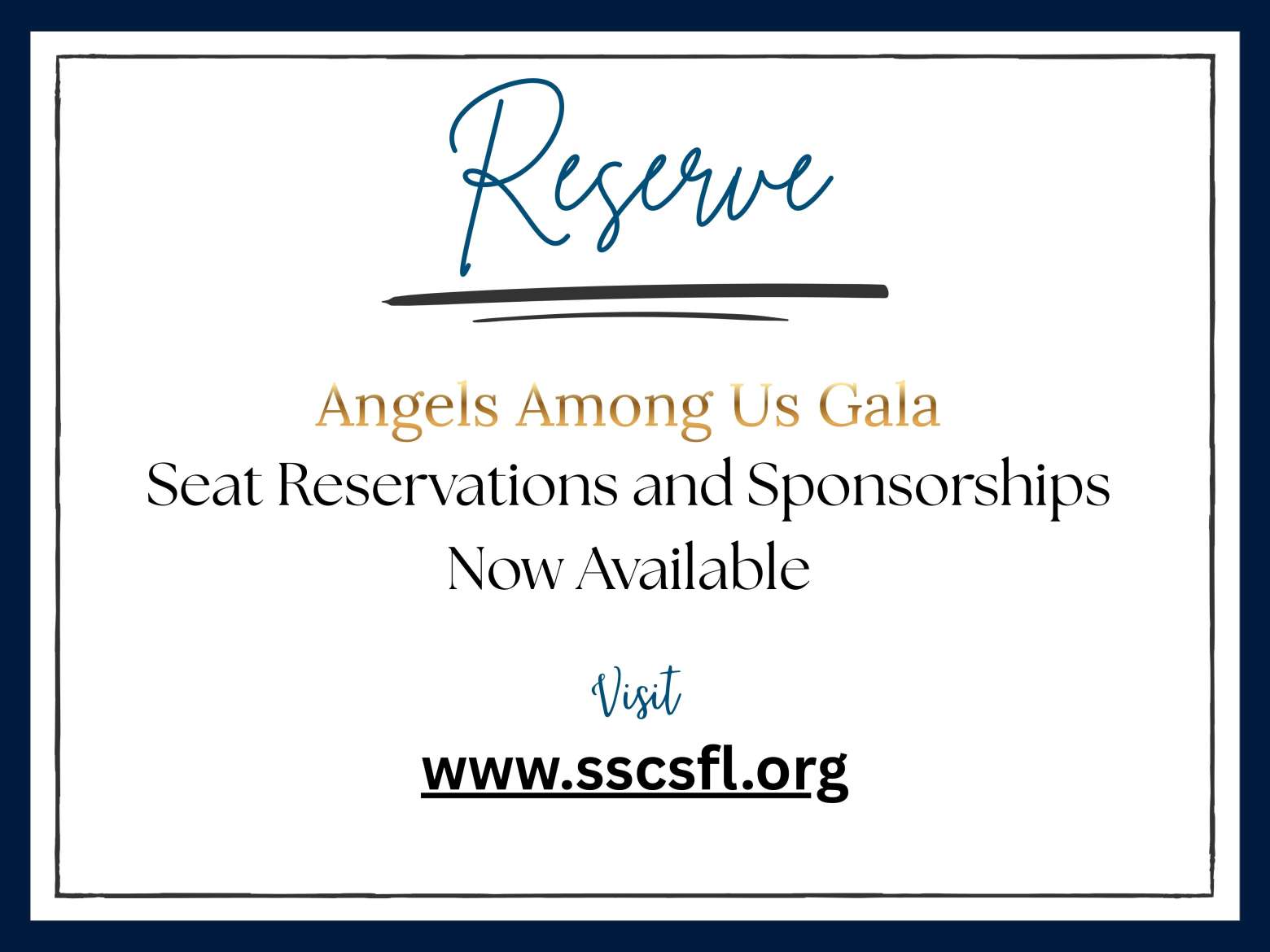
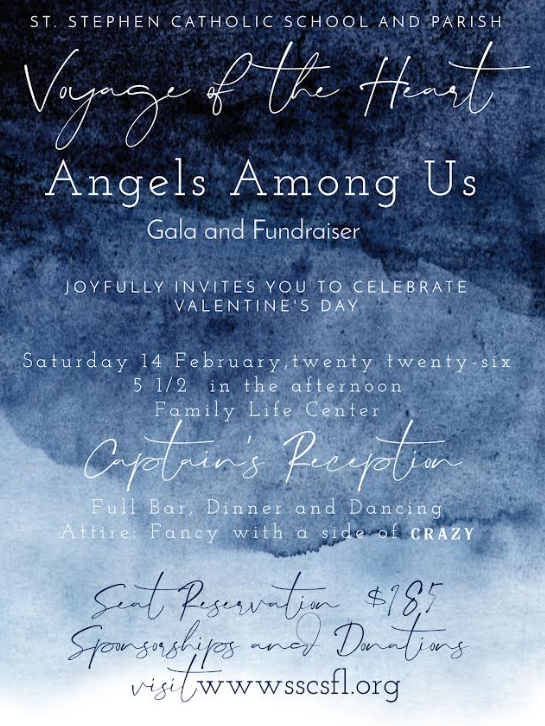
Angels Among Us invites you to Celebrate their 26th Gala Fundraiseron 2/14. Helpful info can be found in Frequently Asked Questions ( see link below). The Gala is a great way to make new friends, and enjoy a fun night out while supporting our school.

Need Babysitting For Angels?
Many parents have asked Angels to help with watching their children while they attend the Gala on 2/14. We recently began offering the service with a nominal charge and it was very well received. We are happy to announce sitting will be available again this year. It will be available to all SSCS students while parents attend the Gala. The children will be watched in our school building.
The nominal charge of $25 for the first child and $10 for each additional child is to compensate the school employees who have agreed to attend to the children. The child can be brought to the school office between 5:15 pm and 5:45 pm. Registration and the fun begins at 5:30 pm. Please feel free to bring water, snacks, a pillow, blanket etc.
Notify ngallagher@sscsfl.org if you plan on using the service.
Please come and enjoy the dinner, open bar, auction opportunities, music and dancing knowing your child is close by.
Use BOGO to get Volunteer Hours And Support the Angels Gala
A volunteer hour is valued at $50 and this is the amount you are charged for every hour not earned. Each school family is required to do 20 hours of volunteer time during the school year. BOGO can help you meet the 20-hour requirement. New families must have 4 of the 20 hours volunteering for the gala.
Angels Among Us will trade volunteer hours for your donation of wine (red, white, Prosecco, Champagne, Rioja). For bottle(s) valued at $45, one volunteer hour will be credited. Your out-of-pocket cost does not have to be $45 but the value of the donation must be at least $45. Thus, BOGO or store sales are great ways to spend less than $45 in exchange for one hour volunteer credit. Each bottle should have a value of no less than $15. Donations are accepted now through 2/1. Please plan on attending the gala fundraiser on 2/14 and join in Celebrating 26 years of Angels supporting SSCS.
Mustang Sports
Girls Basketball:
The varsity has won two of their past three games. They beat Incarnation, 34-6, on the Thursday before the Thanksgiving break. The Mustangs were led in scoring by Christina F. with 11 points, and Mabel R., Sofia S., and Alannah M., with 6 points each. The Mustangs beat Nativity, 25-8, and they were led in scoring by Christina F. with 11 points, and Sofia S. with 6 points. The varsity lost to Mother Teresa, 35-23, to break their three game winning streak. Christina F. had 11 points, and Sofia S., and Alannah M. with 6 points each. The JV beat Incarnation 15-5, to win their second game in a row. The Mustangs were led in scoring by Brielle Mc. with 9 points, and Chelsea M. with 5 points. The JV lost to Nativity, 9-8, and they were led in scoring by Brielle Mc. with 4 points. The Mustangs lost to Mother Teresa, 18-6, and were led in scoring by Brielle Mc. with 4 points.
The girls basketball teams are back on the court today against Christ the King, here at St. Stephen in the FLC. The varsity plays at 4:15 pm and the JV at 5:15 pm. Next week is the last week of the regular season with games on Wednesday against Corpus Christi and Thursday against St. Lawrence. Both games are here at St. Stephen in the FLC. The varsity & JV playoffs are the week of December 15-18.
Boys Track: The boys track team has had practice all week in preparation for the last events of the season next week. The second field event meet is Tuesday, at Christ the King, from 4:00-5:45 pm. The second running and relay meet is next Saturday, December 13, at Jesuit, from 1:30-5:00 pm.
Please see the Athletics webpage for the complete 2025 girls basketball game schedule and boys track meet and event schedule.
Coach Green is looking for volunteers to coach the girls varsity flag football team. The season starts in January when we return from Christmas break. The season runs from January until the first week of March. If you are interested, or need more information please reach out to Coach Green at, ggreen@sscsfl.org
The girls basketball teams are back on the court today against Christ the King, here at St. Stephen in the FLC. The varsity plays at 4:15 pm and the JV at 5:15 pm. Next week is the last week of the regular season with games on Wednesday against Corpus Christi and Thursday against St. Lawrence. Both games are here at St. Stephen in the FLC. The varsity & JV playoffs are the week of December 15-18.
Boys Track: The boys track team has had practice all week in preparation for the last events of the season next week. The second field event meet is Tuesday, at Christ the King, from 4:00-5:45 pm. The second running and relay meet is next Saturday, December 13, at Jesuit, from 1:30-5:00 pm.
Please see the Athletics webpage for the complete 2025 girls basketball game schedule and boys track meet and event schedule.
Coach Green is looking for volunteers to coach the girls varsity flag football team. The season starts in January when we return from Christmas break. The season runs from January until the first week of March. If you are interested, or need more information please reach out to Coach Green at, ggreen@sscsfl.org
GO MUSTANGS!
Coach Green



Gulf Coast Catholic is a print and digital evangelizing magazine and news website of the Diocese of St. Petersburg. Click here to learn more and to subscribe.


PK-3 needs cleaned, empty
16 oz Jif Peanut Butter jars.
Kiddos Lunches


Homeroom Moms
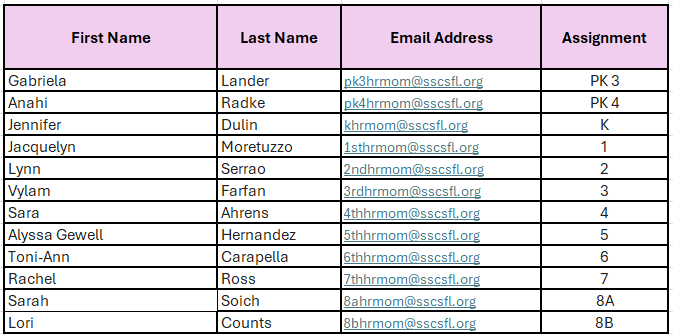
Homeroom moms now have dedicated email addresses. Add them to your contact list and check your junk mailboxes to be sure you do not miss any important classroom information!

Emails for HomeRoom Moms
Answer to the Joke!
Hamazon


Safe Environment Training and Fingerprints
Everyone needs updated safe environment training and fingerprints in order to volunteer in the school or to chaperone a field trip. Safe environment and fingerprints are good for 5 years. Attached here are the instructions on how to get your safe environment certificate and to have your fingerprints done. If you have any questions please contact Karen Biase at kbiase@sscsfl.org or call the front office at ext. 1100. Click the link for information here regarding fingerprints. Click for the live link here. For the safe environment click here for the live link .
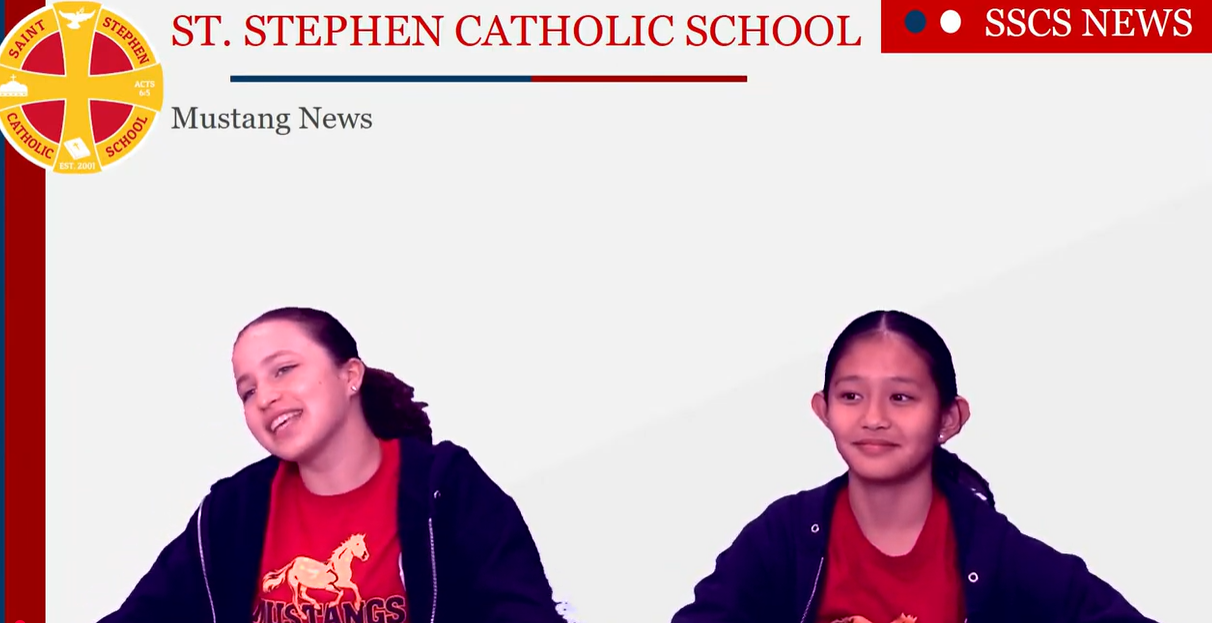
Check out our
Mustang News morning show!
You can join our Mustang News team each morning at 7:50 as we stream live on YouTube to begin the day with prayers, the pledge of allegiance, and news. Subscribe to our channel here.
Like Us on Facebook and
Follow Us on Instagram


Mission Statement
St. Stephen Catholic School is devoted to inspiring students to achieve their full academic potential while demonstrating a desire to continue Jesus' mission by applying Catholic morals, beliefs, values, and practices in their everyday lives. We are committed to motivating students to sustain a lifelong love of learning.